
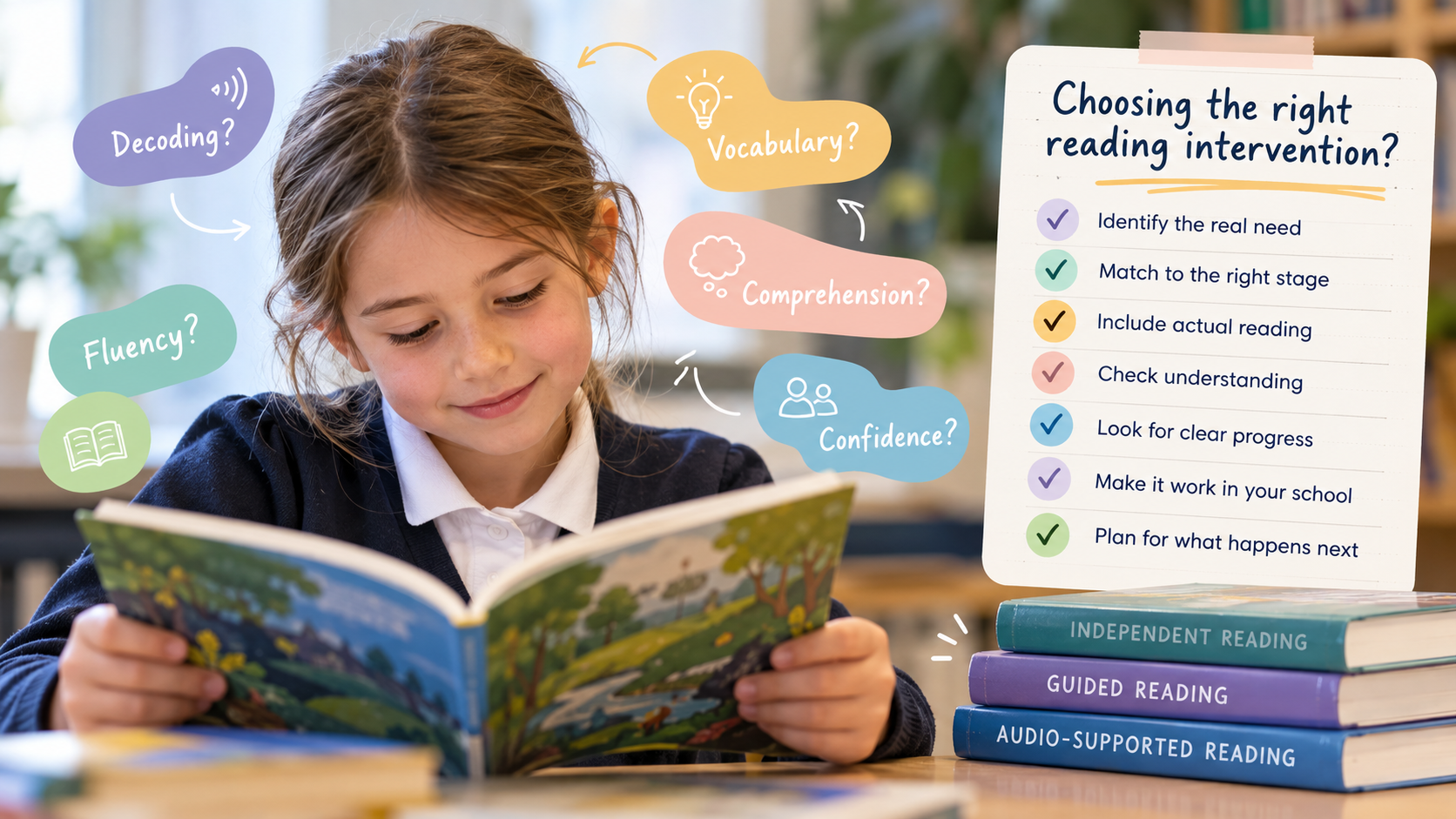
How Do You Choose the Right Reading Intervention? 7 Questions I Think Every School Should Ask
How Do You Choose the Right Reading Intervention? 7 Questions I Think Every School Should Ask
By Amy Rose, Director of Learning Loft
There is a point in almost every school improvement conversation about reading where somebody asks:
“So, which intervention should we use?”
It is an understandable question.
But I increasingly think it is the wrong first question.
Before we choose a programme, platform, intervention group or beautifully colour-coded set of resources, we need to know what the pupil is actually struggling with.
Because “behind in reading” isn't a diagnosis.
A child may struggle to decode.
Another may decode accurately but painfully slowly.
Another may read fluently but understand very little of what they have read.
Another may understand an age-appropriate text perfectly well when it is read aloud but struggle to access it independently.
Another may have the reading skill but not the vocabulary.
And another may have spent so long feeling unsuccessful as a reader that avoidance has become part of the problem.
Putting all six pupils into the same generic “reading intervention” because their reading ages happen to look similar is unlikely to give us the precision we need.
That is why, if I were reviewing reading intervention in a school this term, I wouldn't start with the product catalogue.
I'd start with seven questions.
Why this conversation matters now
Reading intervention is hardly a new priority, but there is interesting work happening around it.
Several significant Education Endowment Foundation reading studies reached completion in September 2026.
One evaluates a technology-supported reading programme with 2,688 struggling Year 2 readers across 224 schools. Another involves 5,406 Year 5 pupils across 124 schools, looking at an online programme targeting comprehension, fluency and vocabulary. The EEF's Fluency Focus pilot, meanwhile, involved around 800 Year 5 pupils in 20 schools and centred specifically on reading fluency and comprehension.
Those studies are different in design and purpose, and completion does not mean we should jump ahead of the published findings.
But I think the wider picture is useful.
Reading intervention is increasingly being examined not as one single thing, but as a combination of different components: decoding, fluency, vocabulary, comprehension, practice, assessment and implementation.
That is exactly how schools should think about it too.
Question 1: What is actually causing the reading difficulty?
This has to come first.
Imagine two Year 5 pupils both appear to be reading significantly below age-related expectations.
Pupil A reads:
The exhausted traveller reached the abandoned cottage before nightfall.
slowly and inaccurately. They stumble over exhausted, guess traveller from its first letter and cannot blend abandoned successfully.
Pupil B reads the entire sentence accurately, at a reasonable pace and with appropriate expression.
But when asked why the traveller might want to reach the cottage before nightfall, Pupil B cannot explain.
These pupils do not have the same reading problem.
Pupil A may need work around decoding and automatic word recognition.
Pupil B may need support with language comprehension, vocabulary, inference or background knowledge.
Giving both pupils identical comprehension worksheets won't solve Pupil A's decoding difficulty.
Giving both pupils additional phonics won't necessarily solve Pupil B's comprehension difficulty.
This sounds obvious when we put the pupils side by side.
Yet school intervention systems can inadvertently do exactly this when entry is determined by one headline score.
Before intervention, diagnose the barrier
I would want to know something about:
- decoding accuracy;
- phonics knowledge where relevant;
- automatic word recognition;
- reading rate;
- phrasing and expression;
- vocabulary;
- literal comprehension;
- inference;
- background knowledge;
- reading stamina.
Not every pupil needs a battery of tests.
But we need enough information to choose an intervention that matches the problem.
Assessment should lead to action. Otherwise we have simply collected another number.
Question 2: Does the intervention match the stage of reading development?
This matters enormously.
Early reading instruction rightly places considerable emphasis on phonics.
The statutory Year 1 phonics screening check itself is designed to establish whether pupils have learned phonic decoding to an age-appropriate standard, using 40 real and pseudo-words. The purpose is diagnostic: identifying pupils who may need additional support. GOV.UK
But reading does not finish when a child can decode.
Once decoding becomes more secure, another challenge emerges:
automaticity.
A pupil can technically read every word in a paragraph and still use so much cognitive effort doing it that very little capacity remains for meaning.
This is why fluency matters.
Fluency connects accurate word reading with comprehension.
A fluent reader isn't merely fast.
They recognise words efficiently, group them into meaningful phrases, respond to punctuation and read with appropriate expression.
So intervention has to move with the pupil.
For one child, the priority may still be phonics.
For another, it may be repeated oral reading.
For another, vocabulary.
For another, comprehension.
For many, it will be a combination.
The question shouldn't be:
“Is this a good reading intervention?”
It should be:
“Is this a good reading intervention for this pupil's current barrier?”
Question 3: Does it include enough actual reading?
This seems almost too obvious to include.
But I would include it anyway.
A reading intervention needs children to read.
Not simply answer questions about reading.
Not spend most of the session completing worksheets.
Not watch somebody else read.
Not spend twenty minutes talking about a book and two minutes actually encountering its sentences.
They need sustained opportunities to practise the thing we're trying to improve.
For pupils developing fluency, this might include:
- hearing fluent reading modelled;
- echo reading;
- paired reading;
- repeated reading;
- reading aloud with feedback;
- following text alongside high-quality audio;
- rereading familiar text;
- gradually increasing independent reading.
The precise balance will depend on the pupil.
But practice matters.
We wouldn't expect somebody to become a fluent pianist primarily by answering questions about pianos.
Reading deserves the same logic.
Question 4: Are we measuring comprehension as well as completion?
This is one I feel quite strongly about.
Schools now have access to wonderful amounts of reading data.
Books completed.
Pages read.
Minutes logged.
Words encountered.
Streaks.
Levels.
Points.
Badges.
All of those things can encourage reading.
But none automatically tells us whether a pupil understood what they read.
A pupil can finish a book without constructing a coherent mental model of it.
They can read every word correctly without understanding a crucial piece of vocabulary.
They can race through text because the system rewards completion.
That is why reading practice needs some form of comprehension check.
It doesn't have to mean an enormous written exercise after every chapter.
Sometimes three carefully chosen questions tell us far more.
What happened?
Why did it happen?
What does this word suggest?
What can we infer?
What evidence supports that idea?
The goal isn't to turn every book into a test.
It is to make sure that reading progress still means understanding.
Question 5: Can teachers actually see whether it is working?
This is where implementation meets workload.
A reading intervention may look excellent on paper, but if the information it produces is impossible for teachers to interpret, it becomes another administrative task.
I'd want a teacher to be able to answer:
Who is improving?
Who isn't?
What aspect of reading is improving?
Who needs a different approach?
Is this pupil becoming more independent?
And I wouldn't want them spending Friday afternoon manually transferring twelve separate scores into another spreadsheet to find out.
Data should shorten the distance between:
“Something isn't working.”
and:
“This is what we should do next.”
That principle applies far beyond reading.
It is one of the reasons I've become increasingly wary of educational technology that produces impressive dashboards containing very little actionable information.
More data isn't automatically better insight.
Question 6: Can the intervention realistically be implemented in this school?
This may be the most underrated question.
We can find an evidence-informed programme with a beautiful theoretical model and still implement it badly.
Imagine an intervention requires:
- four 30-minute sessions every week;
- the same trained adult;
- groups no larger than four;
- a quiet room;
- careful progress monitoring;
- twelve uninterrupted weeks.
But the school can realistically provide:
- two 20-minute sessions;
- different adults depending on cover;
- eight pupils;
- whichever room is free;
- frequent interruptions.
We are no longer really implementing the same intervention.
That doesn't mean schools should only choose easy options.
It means implementation feasibility has to be part of the decision.
Before buying or adopting anything, I would ask:
Who will deliver it?
Teacher? Teaching assistant? Reading lead? Tutor?
How often?
What will actually survive a busy school week?
For how long?
Six weeks? A term? Longer?
What happens when staff are absent?
Does intervention simply disappear?
What training is needed?
Can somebody deliver it well after reading a two-page guide?
What will pupils miss?
This is particularly important.
Taking the same pupil out of science three times a week to improve their reading can create another curriculum gap.
Intervention always has an opportunity cost.
We should acknowledge it.
Question 7: What happens when the intervention ends?
This is perhaps the question I would ask most insistently.
A pupil makes progress during a twelve-week reading intervention.
Wonderful.
Then what?
Do they return to exactly the same reading experience they had beforehand?
Does anybody continue monitoring them?
Can they transfer their improved fluency to science?
History?
Geography?
Exam questions?
More demanding texts?
The purpose of intervention is not to become permanently better at the intervention.
It is to become a better reader.
So we need an exit plan.
That might involve:
- gradually reducing support;
- moving from guided to independent reading;
- checking progress again after six weeks;
- communicating strategies to classroom teachers;
- increasing challenge;
- monitoring whether fluency transfers across subjects;
- giving pupils continued access to appropriate reading material.
The best intervention should eventually make itself less necessary.
Where technology can genuinely help — and where it can't
I run an education technology company, so perhaps I should be the person telling you that technology can solve all of this.
It can't.
A platform cannot replace a knowledgeable reading teacher.
It cannot hear everything a teacher hears.
It cannot understand a child's history with reading in the way somebody who knows them can.
And it certainly cannot manufacture a reading culture.
What technology can do is remove some of the friction.
This is where our own LoftLibrary sits within Learning Loft.
It gives pupils carefully levelled reading material across three reading modes: independent, guided and audio-supported. Books include comprehension quizzes, while teachers can see class and pupil reading progress. It is designed to support reading fluency and comprehension from EYFS through KS3. Learning Loft
The part I care about isn't simply putting books on a screen.
It is the movement between support and independence.
A pupil may initially need audio-supported reading.
Later, they may use guided reading support.
Eventually, we want them reading independently.
That progression matters.
And comprehension remains part of the picture rather than assuming that finishing a text means understanding it.
But LoftLibrary still shouldn't be used because “this child is behind in reading.”
We should first know why.
Technology should serve the diagnosis.
The diagnosis shouldn't be invented to justify the technology.
A simple reading-intervention audit for school leaders
If I were reviewing provision this half term, I'd take every reading intervention currently running and ask:
1. Who is in it?
And why, specifically?
2. What precise reading difficulty is it targeting?
Not “low reading age”. What is the underlying barrier?
3. What does a typical session actually contain?
How many minutes involve genuine reading?
4. How frequently does it happen?
And how frequently does it really happen once absence, cover and school events are included?
5. What evidence would tell us it is working?
What are we measuring?
6. When do we review placement?
Pupils should not remain in intervention because nobody remembered to take them out.
7. What is the exit strategy?
How does the pupil move towards independence?
Those seven questions will probably tell you more than the intervention's brochure.
Don't forget the pupils who can read — but not fluently
There is another group I think schools need to watch particularly carefully.
They often survive primary school without attracting much concern because they can decode.
They don't make spectacular errors.
They can answer straightforward comprehension questions.
But reading remains slow and effortful.
By secondary school, the volume and complexity of text increases dramatically.
Suddenly the pupil has to read:
- a science explanation;
- a history source;
- a geography case study;
- a mathematical word problem;
- an exam question containing unfamiliar vocabulary.
Weak fluency becomes a whole-curriculum issue.
This is why reading cannot belong solely to the English department or primary reading lead.
At secondary level especially, every subject has a reading demand.
A pupil doesn't stop being a struggling reader when they walk into chemistry.
What I would prioritise over buying another intervention
Before adding another programme, I'd want schools to know three things.
Which pupils need help?
Not simply which pupils have a low score.
What help do they need?
Decoding? Fluency? Vocabulary? Comprehension? A combination?
How will we know whether the help worked?
If those answers aren't clear, another intervention probably isn't the first solution.
Better diagnosis might be.
Because ultimately, the question isn't:
“What reading intervention do we have?”
It is:
“Are more children becoming successful, independent readers because of what we're doing?”
Everything else is secondary.
Frequently asked questions
What is a reading intervention?
A reading intervention is additional, targeted support designed to address a specific difficulty with reading. Depending on the pupil, this might focus on phonics and decoding, word recognition, fluency, vocabulary, comprehension or a combination of these areas.
What is the best reading intervention for KS2?
There is no single intervention that is best for every KS2 pupil. Schools should first identify the pupil's underlying reading difficulty and select provision that targets that need. A pupil with weak decoding requires a different emphasis from a fluent decoder who struggles with comprehension.
How do you identify pupils who need reading intervention?
Schools can use a combination of reading assessment, teacher observation, oral reading, phonics information where appropriate, fluency measures and comprehension evidence. A headline reading-age score can flag concern, but further diagnosis is usually needed to identify the specific barrier.
How often should reading intervention take place?
Frequency depends on the intervention and pupil need. What matters is that schools implement the chosen approach with sufficient consistency and intensity, rather than adopting a programme but delivering substantially less practice than intended.
Is reading fluency the same as reading speed?
No. Fluency involves accurate and sufficiently automatic word reading together with appropriate phrasing and expression. Reading faster without understanding the text is not the goal.
Should reading interventions use technology?
Technology can provide useful additional practice, accessible reading modes, immediate feedback and progress information, but it should support rather than replace professional diagnosis and teaching. Schools should choose technology because it addresses an identified need, not simply because it produces more data.
What is LoftLibrary?
LoftLibrary is Learning Loft's reading and comprehension strand for schools and families. It provides levelled books with independent, guided and audio-supported reading modes, built-in comprehension quizzes and progress information for teachers and parents. Learning Loft
The question that matters
We sometimes make school improvement more complicated than it needs to be.
Reading intervention is a good example.
There are programmes, assessments, dashboards, schemes and strategies everywhere.
But underneath all of them is a child trying to make meaning from words on a page.
Start there.
Find the barrier.
Choose the response.
Check whether it worked.
Then change course if it didn't.
That is less glamorous than buying the newest intervention.
But I suspect it is considerably more powerful.
— Amy Rose
Director, Learning Loft
Related: LoftLibrary