
I Taught Both My Boys to Read the Same Way. So Why Did Only One Find It Easy?
By Amy Rose, Director of Learning Loft — but, for this one, mainly mum of two very different boys.
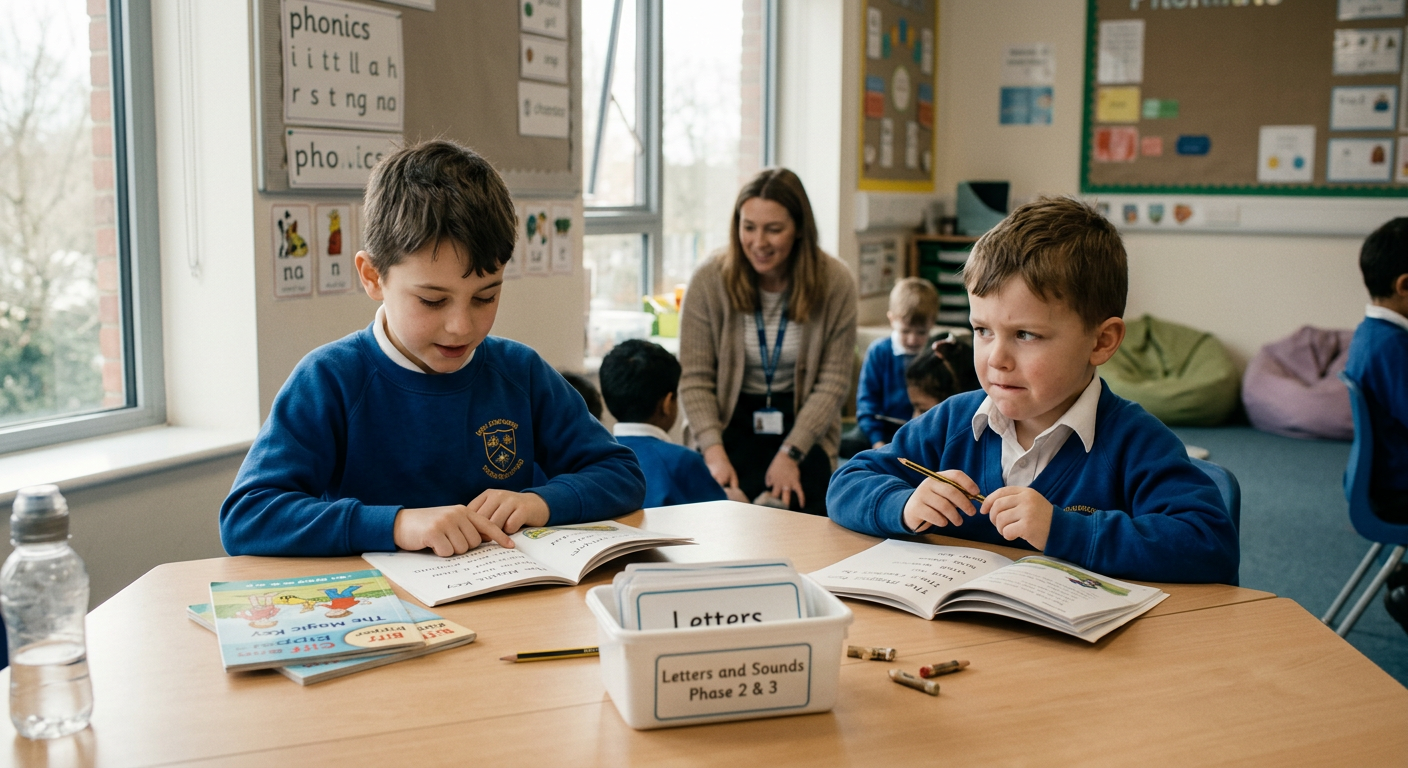
I taught both of my boys phonics.
Same mum. Same sounds. Same sort of books. Same encouragement. Same home.
Completely different experiences.
My eldest was — and still is — very academic. Reading came easily. In fact, most things at school seemed to come fairly easily to him. He picked things up quickly, remembered them and moved on.
Then came my second.
Typical second child in so many ways.
Sociable. Funny. Confident. Incredibly conversational. The sort of child who could probably talk his way out of almost anything.
But academically? Things didn’t always click in quite the same way.
Reading certainly didn’t.
And I remember finding that genuinely mind-boggling.
I had taught them both phonics in the same way. So why hadn’t they learned in the same way?
As a teacher, I knew children learned differently.
As a mum watching it happen in my own house, it suddenly felt very different.
And it reinforced something I think we need to talk about much more when it comes to struggling readers:
Children are not identical learning machines.
The same teaching can go in.
That does not mean the same learning will automatically come out.
Reading is much more complicated than it looks
Watch a confident reader and reading seems almost effortless.
Their eyes move across a sentence and the meaning appears.
But underneath that seemingly simple process, a huge amount is happening.
One of the most established ways of understanding reading is the Simple View of Reading.
Put very simply:
Decoding × Language Comprehension = Reading Comprehension
A child needs to be able to work out the words on the page, but they also need to understand the language those words create.
And those two things do not always develop at the same rate.
A child might talk confidently about dinosaurs for twenty minutes but struggle to independently decode the word dinosaur.
Another child might read a whole paragraph aloud beautifully but have very little idea what they have actually read.
Another might know all of their phonics sounds but find blending them together slow and exhausting.
Another might decode accurately but so slowly that, by the time they reach the end of a sentence, they have forgotten how it started.
We might describe all of those children as struggling readers.
But they are not necessarily struggling with the same thing.
And that matters.
Because if the difficulty is different, the support may need to be different too.
So, does phonics work?
Absolutely.
Systematic phonics teaching is one of the strongest evidence-based approaches we have for early reading.
Research summarised by the Education Endowment Foundation suggests phonics can lead to around five months of additional progress on average, particularly for younger pupils and children who are finding reading difficult.
That is significant.
Phonics gives children the tools to understand the relationship between letters and sounds, blend those sounds together and begin to decode unfamiliar words independently.
It matters enormously.
But phonics is not the whole of reading.
Knowing the sounds is not the same as instantly recognising words.
Recognising words is not the same as reading fluently.
Reading fluently is not the same as understanding.
And understanding a sentence is not always the same as understanding the deeper meaning of a whole text.
Reading is a chain of interconnected skills.
If one part is weaker, the whole process can become much harder.
What actually sits underneath reading?
Alongside phonics, research has identified a number of important skills involved in becoming a confident reader.
These include:
- phonological and phonemic awareness
- letter-sound knowledge
- blending and decoding
- vocabulary
- oral language
- reading fluency
- working memory
- background knowledge
- comprehension
- attention and concentration
- motivation and reading experience
That is quite a list.
And perhaps it helps explain why two children can sit through exactly the same phonics lessons and experience them completely differently.
One child may quickly recognise patterns and begin reading words almost automatically.
Another may need far more repetition before those same patterns stick.
One may have excellent decoding but weaker vocabulary.
Another may have fantastic spoken vocabulary but find getting the words off the page much more difficult.
There is rarely one single picture of a struggling reader.
That was certainly true for my youngest
Language was never his problem.
Quite the opposite.
He could talk.
A lot.
He could tell stories, explain himself, make jokes, negotiate, ask questions and join conversations confidently.
His thinking wasn’t somehow “behind”.
But translating written symbols on a page into words required more effort for him than it had for his brother.
And I think this is an incredibly important distinction for children to understand:
Struggling with reading does not mean lacking intelligence.
A child can have brilliant ideas and find decoding difficult.
A child can understand complex conversations but struggle to read the same vocabulary independently.
A child can listen to a story and understand every twist and turn, yet find reading that story themselves incredibly tiring.
Those children do not need us to reduce our expectations of what they can think about.
They need us to find better ways to help them access it.
Sometimes the child’s spoken language tells us a lot
One of the areas I think we sometimes underestimate when discussing reading is oral language.
Talking matters.
Listening matters.
Vocabulary matters.
Being read to matters.
Discussing a story matters.
Asking why a character behaved in a certain way matters.
Predicting what might happen next matters.
Explaining an opinion matters.
All of these things help to build the language and comprehension skills that children need when they read independently.
So if your child struggles to physically read a book that is suitable for their age, that does not mean they should only ever experience very simple stories.
Read to them.
Listen to audiobooks.
Talk about interesting ideas.
Explain unfamiliar words.
Let them hear rich language.
Their ability to decode should not become a ceiling on what they are allowed to think about.
Then there is fluency
This is another piece of the reading puzzle that can easily get missed.
Imagine having to sound out almost every word you read:
Th-e c-a-t s-a-t o-n th-e m-a-t.
You may eventually arrive at the correct sentence.
But look at how much mental effort it has taken.
Now imagine doing that for a whole page.
Or a whole chapter.
It is exhausting.
As children become more fluent, more words become automatic. They don’t have to consciously decode every single part.
That leaves more mental space available to think about what the text actually means.
This is why a child can appear to “read” something and then answer almost nothing about it afterwards.
They may have used so much effort working out the individual words that there was very little capacity left for comprehension.
Fluent reading acts as a bridge between recognising words and understanding them.
And comprehension is much more than answering three questions
When we talk about reading comprehension, it can sometimes become:
Read this.
Answer these questions.
Finished.
But real comprehension is far richer.
Can the child explain what happened?
Can they work out why something happened?
Can they infer something the writer hasn’t directly stated?
Do they understand an unfamiliar word from its context?
Can they explain how a character might be feeling?
Can they make a sensible prediction?
Can they connect something they have read to knowledge they already have?
Can they remember the important parts?
Reading isn’t successful simply because every word was pronounced correctly.
The goal is meaning.
The part that concerns me most isn’t always the reading level
It’s confidence.
Children notice more than we sometimes realise.
They notice who finishes first.
They notice who is on the “harder” books.
They notice when another child reads something instantly that took them several attempts.
They notice when reading aloud feels uncomfortable.
And slowly:
“Reading is hard” can become “I’m bad at reading.”
Then:
“I’m bad at reading” becomes “I don’t like reading.”
And that is a much harder barrier to break down.
Recent research from the National Literacy Trust continues to show worrying levels of reading enjoyment among children and young people.
Only around a third of 8–18-year-olds currently say that they enjoy reading in their free time.
That should make all of us working with children stop and think.
Because reading ability matters enormously.
But so does creating children who actually want to read.
Telling a struggling reader to “read more” isn’t always enough
Imagine being terrible at tennis.
Every time you play, everybody around you seems better.
You miss the ball repeatedly.
You feel embarrassed.
Then someone tells you the solution is:
Play more tennis.
Technically, they may have a point.
Practice matters.
But without teaching, support and some experiences of success, you’re probably not going to develop a lifelong love of tennis.
Reading can be similar.
Children need opportunities to practise.
But they also need reading experiences that feel achievable and worthwhile.
They need books and stories that interest them.
They need adults reading with them.
They need to hear fluent reading modelled.
They need explicit teaching where skills are weak.
And sometimes they just need the pressure taken off enough to remember that stories can actually be enjoyable.
What should we look for when a child is struggling?
Rather than simply asking, “Why aren’t they reading at the expected level?”, we can start asking more useful questions.
Can they hear the individual sounds in words?
Do they know their letter-sound correspondences securely?
Can they blend sounds together?
Can they decode an unfamiliar word rather than guess from the first letter?
Are common words becoming automatic?
Is their reading accurate but extremely slow?
Does their reading sound fluent?
Can they explain what they have just read?
What happens if an adult reads the same passage to them instead?
Do they suddenly understand it much better?
Is vocabulary getting in the way?
Can they retell the important parts?
Are they struggling to make inferences?
Are they avoiding reading because it is difficult?
These questions start to tell us where the barrier might actually be.
That gives us a far better starting point than simply labelling a child a struggling reader.
Sometimes there may be something more specific going on
For some children, persistent difficulties with word reading and decoding can be associated with dyslexia.
But not every child who finds reading difficult has dyslexia.
Equally, difficulties should not automatically be dismissed as a child simply needing to “try harder”.
If progress remains significantly slower than expected despite good teaching and appropriate support, it is worth looking more closely at the pattern of difficulty.
The important thing is identifying what the child needs rather than rushing towards a label — or avoiding one when further investigation may genuinely help.
Same teaching. Different children.
I think this is probably the biggest lesson my two boys taught me.
We sometimes confuse fairness in education with giving every child exactly the same thing.
But children don’t necessarily need exactly the same thing.
My boys had the same mum.
They were taught phonics.
They had books available.
They were encouraged.
And they still learned differently.
One found reading incredibly straightforward.
One needed things revisiting, practising and approaching differently.
Neither tells me anything about their worth.
Neither tells me everything about their intelligence.
It tells me something about how they learn.
And recognising that distinction is incredibly important.
Perhaps we need to change the question
Instead of:
“Why can’t they read this yet?”
Perhaps we should ask:
“What part of reading hasn’t clicked yet?”
Because once we understand that, we can do something useful.
We can teach the missing skill.
We can practise it.
We can revisit it differently.
We can build fluency.
We can develop vocabulary.
We can talk.
We can read aloud.
We can give children opportunities to succeed.
And, throughout all of that, we can protect their confidence.
And this is exactly why we built the Learning Loft Interactive Library
When we built Learning Loft, we knew we didn’t want reading practice to feel like another worksheet.
We didn’t want children clicking through endless comprehension exercises with no real reason to care about what they were reading.
We wanted children to want to know what happens next.
So we created our Interactive Library, filled with stories built around Larry the Learning Loft bat and his friends.
Larry and the gang head off on adventures throughout the library, meeting new characters, exploring different places and finding themselves in all sorts of situations along the way.
Children begin to recognise the characters.
They start following their adventures.
And reading begins to feel a little less like a task and a little more like a story they actually want to continue.
But underneath all of that fun, there is purposeful reading practice too.
The Interactive Library gives children opportunities to work on reading fluency, helping them develop smoother, more confident reading rather than simply decoding word by word.
It supports comprehension, encouraging children to think about what they have read rather than simply reach the end of the page.
And after each story, children can complete interactive quizzes designed to check their understanding.
Because we don’t just want children to be able to say the words.
We want them to understand them.
Remember them.
Think about them.
Talk about them.
And eventually, enjoy them.
For a confident reader, that might mean another exciting story to explore.
For a struggling reader, it might mean something even more important:
a positive reading experience.
A chance to finish something.
A chance to get the questions right.
A chance to feel successful.
A chance to think:
“Actually, maybe I can do this.”
And sometimes that is where everything begins to change.
Freebie Friday: Supporting Struggling Readers
For this week’s Freebie Friday, we have also created a free Learning Loft guide specifically for parents and teachers supporting struggling readers.
It helps you think more carefully about why a child might be struggling, what signs to look for and practical ways you can support reading without turning it into a daily battle.
Because there isn’t one type of struggling reader.
And there isn’t one solution that works for every child.
My two boys taught me that very clearly.
Same mum. Same phonics. Same encouragement. Two completely different readers.
Mind-boggling at the time.
But actually, when you understand just how complex reading is, perhaps not so surprising after all.
And maybe our job isn’t to make every child learn in exactly the same way.
Maybe it’s to understand them well enough to work out the way that helps them learn best.