
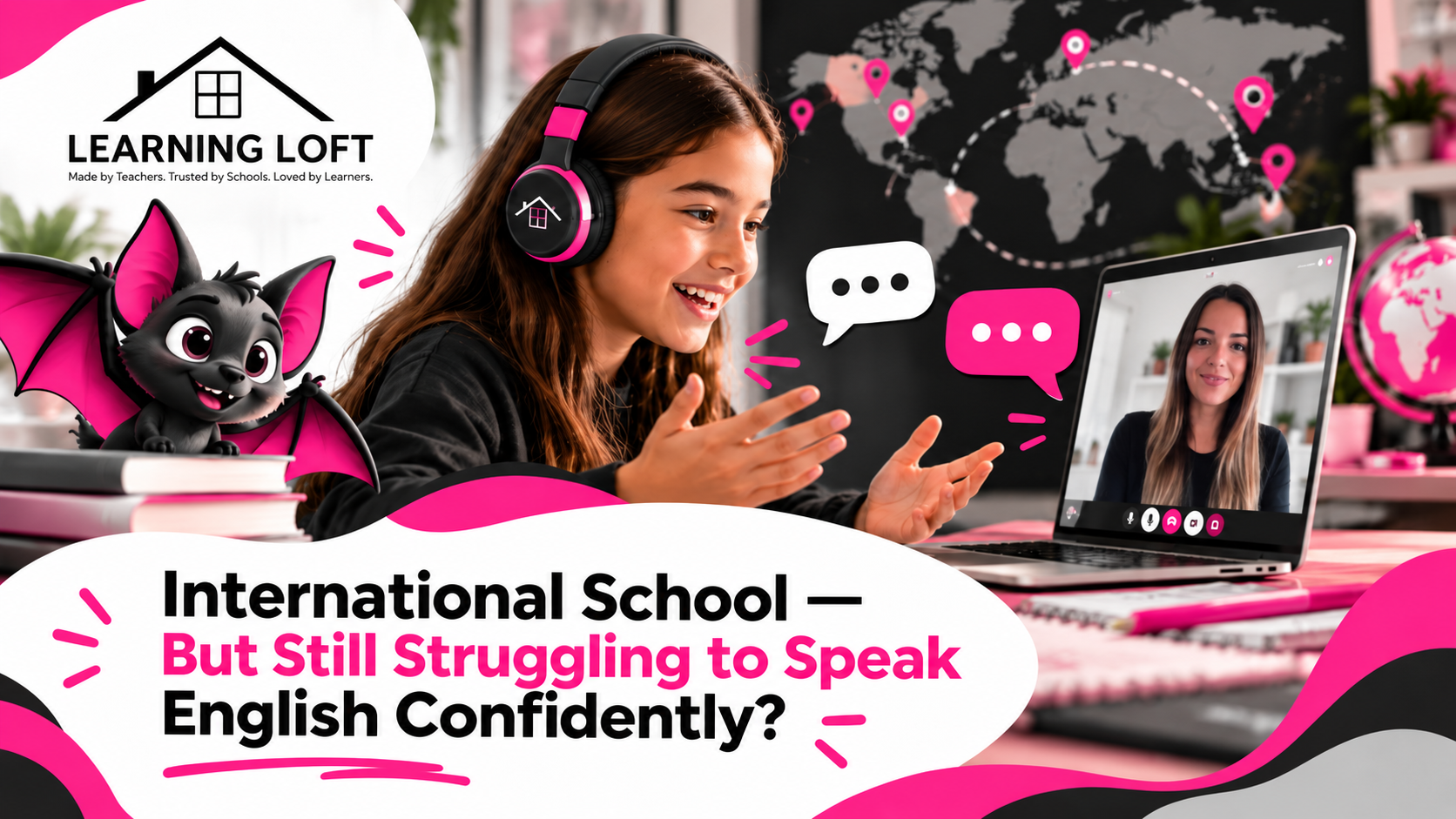
My Child Goes to an International School — So Why Is Their Spoken English Still Falling Behind?
Choosing an international school can give children access to excellent teaching, an international outlook and, in many cases, a curriculum delivered partly or fully in English.
But some parents notice something unexpected.
Their child may be completing schoolwork in English, reading English texts and even achieving good academic results — yet still hesitate when they need to speak naturally, explain an idea aloud or hold a confident conversation in English.
If that sounds familiar, it does not automatically mean that anything is wrong with the school.
It can simply mean that learning English academically and becoming a confident English speaker are not exactly the same thing.
A child can understand English without feeling confident speaking it
There is a big difference between recognising vocabulary on a worksheet and being able to use that vocabulary spontaneously in conversation.
A student might understand a teacher’s instructions perfectly but still struggle to answer quickly.
They may be able to write a strong paragraph but pause when asked to explain the same idea aloud.
They may know the correct grammar but avoid speaking because they are worried about making mistakes.
For international students, that gap can become particularly noticeable as they move into more demanding year groups.
Secondary students are expected to discuss ideas, justify opinions, analyse texts, contribute in lessons and explain increasingly complex concepts.
Primary children may be expected to retell stories, explain mathematical reasoning, describe scientific ideas and participate confidently in classroom discussion.
Speaking therefore becomes part of learning across the curriculum — not just something needed in English lessons.
Why can this happen in an international school?
International schools vary enormously, and many provide excellent English-language education.
However, children in multilingual environments may naturally spend parts of their day communicating with friends and family in other languages.
They may also become very good at the specific academic English needed for lessons without necessarily getting long periods of individual English conversation.
In a busy classroom, a child might only speak for a relatively small proportion of a lesson.
That can be enough to understand the curriculum, but not always enough to develop the speed, confidence and flexibility that come from sustained conversation.
Some students also become skilled at staying quiet.
They listen.
They complete the work.
They achieve reasonable grades.
Because they are coping academically, their lack of speaking confidence can be easy to miss.
Spoken English supports academic English too
Speaking practice is not separate from academic progress.
Being able to explain an idea aloud can help students organise their thinking.
Discussing a text can help them develop interpretations before writing an essay.
Explaining a mathematical method can reveal whether they genuinely understand it.
Talking through a science concept can expose vocabulary gaps that might otherwise remain hidden.
For older students, spoken confidence can also support presentations, oral assessments, classroom participation and preparation for future study.
The goal therefore should not necessarily be “conversation classes” on one side and “academic tutoring” on the other.
For many international students, the strongest support combines both.
They need opportunities to speak naturally in English while also developing the vocabulary, comprehension, writing and subject knowledge required at school.
What does effective English tutoring look like for an international student?
Good online English tutoring should involve far more than simply correcting grammar.
A strong tutor should encourage the student to explain, question, discuss and justify.
For example, a lesson might begin with a short conversation about a familiar topic before moving into reading comprehension.
The tutor might ask the student to explain what they think a character is feeling and why.
Rather than accepting a one-word answer, the tutor can gently extend it.
“What makes you think that?”
“Can you explain that in another way?”
“What evidence can you find?”
“What would you say if you disagreed?”
That type of questioning builds both academic thinking and spoken confidence.
A secondary English student might discuss a GCSE or IGCSE text before writing an analytical paragraph.
A primary student might explain a story, describe an image or talk through the steps used to solve a problem.
An EAL student might practise using new vocabulary naturally before applying it in schoolwork.
The English conversation is therefore purposeful.
It supports the student’s wider education.
Why regular one-to-one conversation can help
One-to-one tutoring gives students something that can be difficult to reproduce in a classroom of twenty or thirty pupils: sustained individual speaking time.
The tutor can adjust the pace immediately.
If the student needs more time to formulate an answer, they can have it.
If their vocabulary is too simple for their age, the tutor can introduce alternatives.
If pronunciation is making them difficult to understand, this can be addressed sensitively.
If they are capable academically but simply reluctant to speak, the tutor can create a low-pressure environment in which they gradually become more confident.
That individual attention is particularly useful for children who are afraid of getting English “wrong” in front of classmates.
Mistakes become part of the lesson rather than something embarrassing.
British curriculum knowledge matters too
For families following a British curriculum overseas, spoken-English support becomes even more valuable when the tutor also understands what the student is expected to do academically.
A child preparing for GCSE or IGCSE English needs more than general conversation.
They need to analyse texts, structure arguments, select evidence and communicate ideas precisely.
A primary pupil following the British curriculum needs vocabulary and speaking work that supports reading, writing, spelling, grammar and wider classroom learning.
This is why the choice of tutor matters.
Parents may want to ask whether a tutor understands the British curriculum, the student’s age-related expectations and the style of work they are completing at school.
What signs might suggest your child needs more spoken-English support?
Parents often notice the problem before it appears clearly in school reports.
Your child may:
understand English better than they can speak it
give very short answers even when they know more
avoid conversations with English-speaking adults
struggle to find the right words quickly
translate mentally before answering
write more confidently than they speak
understand school vocabulary but struggle with everyday conversation
lack confidence explaining ideas aloud
become anxious about pronunciation or making mistakes
find English discussion easier one-to-one than in a classroom
None of these automatically indicate a serious difficulty.
They may simply show that the child needs more opportunities to actively use English.
The aim is confidence, not perfection
Children do not need perfect accents or flawless grammar before they should feel comfortable speaking.
In fact, waiting for perfection can become part of the problem.
The more a child speaks, the more opportunities they have to experiment with vocabulary, notice errors, receive feedback and become faster at expressing themselves.
Confidence often grows through use.
That is why effective tuition should create plenty of opportunities for the student to do the talking.
The tutor is there to guide, model, correct and extend — not dominate the conversation.
English support for international families at Learning Loft
Learning Loft supports students in the UK and internationally through live online tuition with UK-based teachers and tutors.
For international students, English tuition can combine academic support with opportunities to develop spoken confidence.
Lessons can be adapted to the child’s age, curriculum, current level and individual goals.
Support may include:
English language and literacy
EAL support
spoken confidence
reading comprehension
vocabulary development
creative and analytical writing
GCSE English
IGCSE English
British curriculum support
primary English
secondary English
The aim is not simply to help a child complete their next piece of homework.
It is to help them become a more confident, independent communicator who can use English successfully across their education.
Is your child learning in English but still reluctant to speak it?
That gap is more common than many parents expect.
The right support can give a student regular opportunities to speak, think, explain and learn in English while still keeping their academic progress at the centre of each lesson.
For international families, that can be an important bridge between understanding English and genuinely feeling confident using it.
Related: LoftClass