
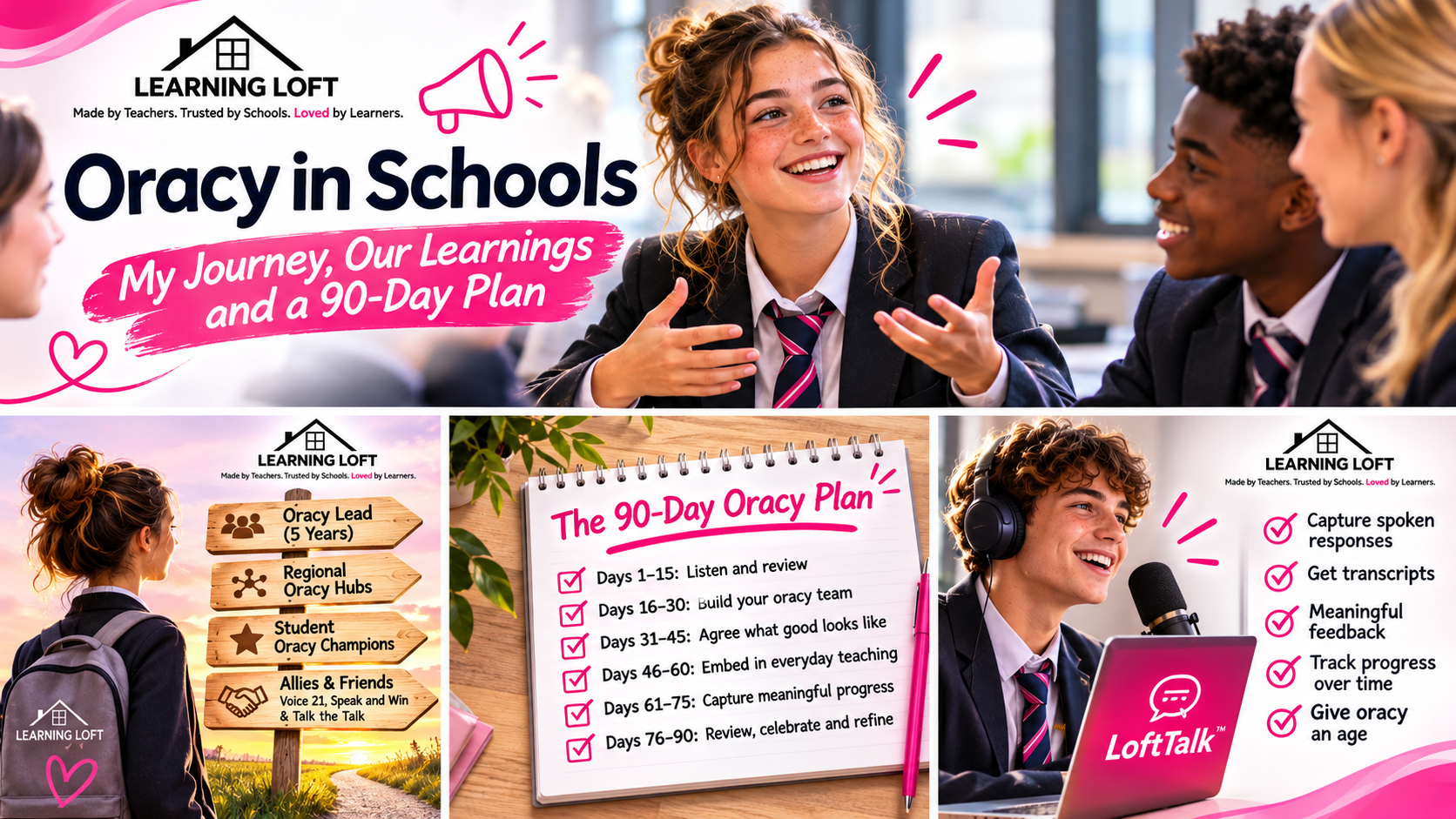
I Championed Oracy Before It Became a Government Priority
I Championed Oracy Before It Became a Government Priority. Here’s What Schools Should Do Next.
By Amy Rose, Director of Learning Loft
For five years, oracy wasn’t just part of my job. It was one of the things I cared about most.
Long before oracy became a headline in government announcements, I was fortunate enough to lead its development across a large multi-academy trust here in the UK.
And I absolutely loved it.
At the time, we were having conversations about the importance of speaking and listening that I wish the wider education system had been having much earlier.
We talked about pupils who could write a brilliant answer but couldn’t explain their thinking aloud. Children who had wonderful ideas but rarely volunteered to share them. Confident speakers who dominated discussions, and quieter pupils whose contributions were just as valuable but far less frequently heard.
We talked about what it really meant to give every child a voice.
And we didn’t just talk about it. We built something around it.
We developed regional oracy hubs. We created opportunities for staff to collaborate across schools. We introduced student oracy champions so that young people themselves could promote the importance of communication and help shape the culture of their schools.
Oracy wasn’t something we wanted confined to English lessons.
We wanted it in mathematics, science, history, assemblies, corridors and classrooms. We wanted pupils to question, challenge, reason, explain, listen and feel that their contributions mattered.
And while oracy was still fighting for the national recognition it deserved, there were some wonderful people and organisations flying the flag alongside us.
Voice 21, Speak and Win and Talk the Talk were among those championing the importance of spoken communication long before it became a government priority.
And I have to give a special mention to Si at Speak and Win, who became a good friend along the way.
We became allies through our shared belief that oracy deserved so much more attention in education. We knew we were flying the same flag, fighting for the same recognition and working towards the same goal: ensuring that every child had the opportunity to develop and use their voice.
There was something quite special about finding people who understood exactly why this mattered, particularly at a time when oracy wasn’t always at the top of the educational agenda.
We weren’t waiting for the government to tell us that speaking and listening were important.
We already knew. And we were determined to do something about it.
So when I saw the government’s announcement in October 2026 about giving oracy equal status to reading and writing in the revised English curriculum, I couldn’t help but smile.
I thought about those conversations, those friendships, the regional oracy hubs, our student champions and all the people who had been pushing for this recognition for years.
Finally, the rest of the education system was catching up with something we’d believed in all along.
But I also found myself thinking about something that had bothered me throughout those five years.
We could teach oracy. We could celebrate it. We could create wonderful opportunities for pupils to speak.
But how could we properly capture their progress?
That question eventually became one of the reasons I created LoftTalk.
And it’s why I believe the next chapter of oracy in schools needs to be about much more than simply encouraging children to speak.
It needs to be about helping them develop, recognising their progress and making sure that no child’s voice disappears the moment they stop talking.
Oracy is finally receiving the recognition it deserves
In October 2026, the government announced plans to give oracy equal status to reading and writing as a distinct strand of the revised English curriculum.
This builds on the Curriculum and Assessment Review, which recommended a stronger focus on spoken language and clearer progression in communication skills.
The government’s plans include a primary oracy framework and a combined secondary framework for oracy, reading and writing.
These are important developments, although the detailed revised curriculum and associated arrangements are still being developed.
For those of us who have spent years championing oracy, the recognition is welcome.
But let’s be clear: schools haven’t suddenly discovered speaking and listening in 2026.
There have been brilliant teachers, school leaders, researchers and organisations developing oracy education for many years.
What has been missing is consistent national recognition, clear progression and a shared understanding of how to assess it meaningfully.
And that final point is particularly close to my heart.
What five years leading oracy taught me
When you lead an initiative across multiple schools, you quickly discover that having a good idea is only the beginning.
You need people to believe in it.
You need staff to understand it.
You need pupils to feel ownership of it.
And you need it to become part of everyday school life rather than another project that disappears when priorities change.
During my time leading oracy, three things became especially important to me.
1. Oracy needs a community, not just a coordinator
One of the things I was most proud of was the development of our regional oracy hubs.
Working across a large trust gave us the opportunity to bring schools together, share practice and develop a common understanding of what purposeful talk could look like.
But we also recognised that schools needed flexibility.
What worked in one classroom wasn’t necessarily going to look identical in another.
An effective oracy strategy needed shared principles, professional dialogue and opportunities for teachers to learn from one another.
I still believe that today.
If I were introducing oracy across a trust now, I would absolutely bring schools together through regional oracy hubs again.
Not to create more meetings, but to create opportunities for teachers to share what is working, explore challenges and celebrate the impact on pupils.
2. Students need to lead the conversation too
Another initiative I loved was introducing student oracy champions.
Because if we’re serious about pupil voice, surely pupils should be involved in promoting it?
The idea was to give young people a meaningful role in encouraging others to communicate, listen and contribute.
Not simply to select the most confident speakers.
In fact, I would argue that some of the most valuable oracy champions are those who understand what it feels like to find speaking difficult.
They can help schools think differently about participation, confidence and inclusion.
Imagine a group of pupils helping to develop discussion expectations, encouraging respectful debate, supporting younger learners or feeding back to leaders about where pupils feel comfortable sharing their ideas.
That’s when oracy begins to become part of a school’s culture.
3. Oracy must be taught, not just encouraged
We can tell pupils to speak confidently.
We can ask them to discuss an idea.
We can invite them to explain their answer.
But unless we’ve actually taught the skills required, we’re often assessing something we haven’t properly developed.
Pupils need models.
They need opportunities to rehearse.
They need language structures, feedback and repeated practice.
They need to understand what makes an explanation clear, how to challenge an idea respectfully and how to adapt their communication to different audiences.
And they need to see themselves improving.
Which brings me to the problem I couldn’t stop thinking about.
The biggest problem with assessing oracy? Once you’ve said it, it’s gone.
Think about how we assess writing.
A pupil writes a paragraph.
We can read it, annotate it, highlight strengths, identify misconceptions and compare it with something they wrote six months earlier.
We can show the pupil how they’ve improved.
We can share examples with parents.
We can moderate work across departments.
We have evidence.
Now think about speaking.
A pupil delivers an excellent explanation in a science lesson.
Another pupil struggles to organise their ideas during a discussion.
A third demonstrates a huge improvement in confidence and vocabulary during a presentation.
And then the lesson ends.
The words are gone.
Unless somebody has recorded them, written detailed notes or remembered the exact contribution, there may be very little evidence of what actually happened.
Of course, teachers make valuable professional judgements every day. I’m not suggesting that meaningful assessment can only happen through recordings.
But I kept coming back to the same frustration.
Why could we so easily revisit a child’s written work, but not their spoken work?
Why could we show a pupil how their writing had developed over a year, but struggle to demonstrate the same progression in their spoken communication?
Why did we have detailed systems for tracking reading and writing, while oracy so often depended on isolated observations and professional memory?
And perhaps most importantly, how could pupils recognise their own development if they couldn’t revisit where they had started?
That was the beginning of LoftTalk.
Why I created LoftTalk — and why it became one of my first loves at Learning Loft
When I started developing Learning Loft, I knew I wanted to create technology that solved genuine problems teachers experienced.
Not technology for the sake of technology.
Not another platform that looked impressive but added to workload.
Something useful.
And LoftTalk was one of the ideas I cared about most.
Because I had experienced the challenge myself.
I wanted to give spoken language something that written work already had: a record, meaningful feedback and a visible journey of improvement.
I wanted a pupil to be able to complete a speaking task, revisit their response, understand their strengths and see exactly what they could work on next.
I wanted teachers to have access to a transcript rather than trying to remember every word.
I wanted school leaders to see patterns in spoken communication without asking teachers to produce endless additional paperwork.
And I wanted to make oracy assessment exciting, purposeful and accessible.
Giving oracy an age
One of the features I particularly wanted to explore was the idea of an Oracy Age.
We are familiar with the language of reading ages.
Parents, teachers and pupils often understand the idea of using an age-related indicator to support conversations about development.
So I asked myself: could we make progress in spoken communication easier to understand too?
That thinking became part of LoftTalk.
Its Oracy Age indicator is designed to give pupils and teachers an accessible developmental reference point alongside feedback about their speaking skills.
It is important to be clear that this is a Learning Loft assessment indicator, not a nationally standardised or government-approved oracy age.
It should never replace teacher judgement or be treated as a complete measure of a child’s communication ability.
But I believe accessible feedback matters.
A pupil should be able to understand more than a number.
They should know what they did well.
They should know what to practise.
And they should have an opportunity to demonstrate improvement.
More than a score
LoftTalk supports structured speaking tasks, transcripts and rubric-based feedback, with teachers reviewing assessment judgements.
It can help identify strengths and next steps across different aspects of communication.
That might mean a pupil is beginning to use more precise vocabulary, developing stronger reasoning or improving how they structure an explanation.
It might mean they are becoming more effective at responding to a question or building on another person’s contribution.
The value is not simply in producing a result.
It’s in making spoken communication something pupils can reflect on, revisit and improve.
I didn’t want to make children speak more just so we could assess them. I wanted assessment to help children become better communicators.
That distinction is everything.
Oracy assessment must be inclusive
There’s another reason I care deeply about how we assess speaking and listening.
We need to be extremely careful about what we’re rewarding.
The loudest child isn’t necessarily the strongest communicator.
The pupil who speaks most quickly isn’t necessarily the most knowledgeable.
And a child who needs additional processing time may have exceptional ideas that simply take longer to express.
Schools must consider pupils with SEND, pupils learning English as an additional language and pupils who communicate in different ways.
Oracy includes more than polished public speaking.
It involves listening, reasoning, interacting and communicating meaning.
The Curriculum and Assessment Review recognises the importance of different forms of communication, including sign language and alternative and augmentative communication.
That matters.
Any assessment system must be interpreted carefully, with appropriate adjustments and teacher oversight.
We should never use an age-related indicator to label a child or reduce their potential to a single score.
For me, the aim is to make progress more visible while respecting the individuality of every learner.
What should schools do now? My 90-day oracy plan
If I were leading oracy across a multi-academy trust again tomorrow, I wouldn’t begin by writing a 40-page policy.
I would start by building a shared understanding, identifying good practice and giving pupils a genuine role.
Here is how I would approach the first 90 days.
Days 1–15: Listen before you launch
Before introducing anything new, find out what is already happening.
Visit a small sample of lessons.
Speak to teachers.
Most importantly, speak to pupils.
Ask:
- When do you feel most confident sharing your ideas?
- What makes it difficult to contribute?
- Do you know how to improve your speaking and listening?
- Do you get feedback on how you communicate?
- Are some pupils heard more often than others?
I would also look at the range of opportunities pupils have.
Are they explaining their thinking in mathematics?
Are they debating interpretations in history?
Are they practising precise scientific explanations?
Are they learning to listen and respond respectfully?
The aim isn’t to catch teachers doing something wrong.
It’s to understand the starting point.
My advice: identify what is already working before adding anything new.
Days 16–30: Build your oracy team
This is where I would return to one of the approaches I loved most.
Create a network.
For a single school, that might mean an oracy lead working with representatives from different phases or departments.
For a multi-academy trust, I would consider regional oracy hubs.
Give colleagues opportunities to share classroom practice, discuss progression and explore assessment.
And please don’t forget the pupils.
Introduce student oracy champions.
Give them a meaningful role.
Ask them to help promote listening, discussion and respectful communication.
Let them share their experiences with school leaders.
Because a strategy about pupil voice should never be developed without pupils.
Days 31–45: Agree what good oracy looks like
One of the most useful starting points is the Oracy Framework developed by Voice 21 and Oracy Cambridge.
It identifies four strands:
Physical: voice and non-verbal communication.
Linguistic: vocabulary, language and spoken structure.
Cognitive: reasoning, organisation and developing ideas.
Social and emotional: listening, responding and working with others.
These provide a shared language for professional discussion.
But I would avoid trying to assess every element immediately.
Choose a few priorities that matter most to your pupils.
For example, your first term might focus on explaining reasoning, responding to others and using precise subject vocabulary.
Then build progression gradually.
A Year 2 pupil explaining a choice with a simple reason is demonstrating something different from a Year 10 pupil evaluating competing arguments.
Our expectations need to reflect that.
Days 46–60: Make oracy part of teaching, not another lesson
This is where I would focus heavily on professional development.
Teachers need practical approaches they can use within the curriculum they already teach.
Here are three I would start with.
Think, rehearse, respond
Give pupils time to think independently before discussing their ideas with a partner.
Then invite responses.
This creates space for pupils who need time to organise their thinking and reduces reliance on the same confident volunteers.
Agree, build, challenge
Teach pupils to respond constructively.
“I agree because…”
“I would like to build on that by…”
“I see it differently because…”
Over time, pupils should become less reliant on these structures.
But they provide an important starting point.
Say it, improve it, write it
This is one of my favourite ways to connect oracy with academic progress.
Ask a pupil to explain an idea aloud.
Model how to improve the explanation.
Give them another opportunity to rehearse.
Then ask them to write.
The spoken rehearsal becomes part of the learning process, not an activity that sits separately from the written outcome.
Days 61–75: Start capturing meaningful progress
This is the stage where I would introduce a small number of carefully chosen assessment opportunities.
Not every conversation needs recording.
Not every contribution needs scoring.
And teachers certainly don’t need another mountain of paperwork.
Instead, select appropriate tasks that allow pupils to demonstrate specific communication skills.
For example:
A Year 4 pupil might explain a scientific prediction.
A Year 7 pupil might present a viewpoint supported by evidence.
A Year 9 pupil might respond to a challenging question.
A Year 11 pupil might deliver and reflect on a prepared presentation.
Assess the relevant skills, provide feedback and give pupils another opportunity later to demonstrate improvement.
This is also where a tool such as LoftTalk can support teachers by capturing spoken responses, providing transcripts and organising feedback for professional review.
The point is to create a meaningful record, not to record everything pupils say.
Days 76–90: Review, celebrate and refine
At the end of the first 90 days, bring your teachers, leaders and student champions together.
Ask what has changed.
Are more pupils participating?
Are pupils explaining ideas more clearly?
Do they understand what makes an effective spoken response?
Are teachers noticing stronger reasoning and subject vocabulary?
Can pupils recognise their own improvement?
And crucially, is the approach manageable?
If teachers are spending more time completing paperwork than developing pupils’ communication, something needs to change.
I would also celebrate the progress.
Share examples of effective classroom practice.
Invite student champions to present their experiences.
Recognise pupils who have developed confidence, improved their listening or become more thoughtful contributors.
Not just the children who can deliver a brilliant speech in front of hundreds of people.
The quieter successes matter too.
Oracy across the curriculum: what this could look like
A whole-school strategy doesn’t mean every subject needs to teach oracy in exactly the same way.
Different subjects require different forms of communication.
In mathematics, pupils might explain why a particular method works.
In science, they might justify a hypothesis using evidence.
In history, they might evaluate competing interpretations.
In English, they might explore character motivation or debate a writer’s intentions.
In primary classrooms, pupils might practise storytelling, listening, questioning and explaining their choices.
The common principle is purposeful talk.
Pupils should understand why they are speaking, what makes the communication effective and how it supports their learning.
And teachers should be able to identify what pupils need next.
That’s far more valuable than simply asking pupils to talk to the person next to them.
What I would do differently if I were leading oracy again
Looking back on those five years, there is so much I would do again.
The regional hubs.
The collaboration between schools.
The enthusiasm of colleagues who understood how important oracy could be.
The student champions.
The opportunities for pupils to take ownership of their voices.
And the friendships made along the way, including people like Si at Speak and Win, who reminded me that we weren’t alone in believing this work mattered.
But there is one thing I would change.
I would build assessment and progression into the strategy from the very beginning.
Not because I believe everything children do should be measured.
Quite the opposite.
I believe assessment should be selective, meaningful and useful.
But I wouldn’t want pupils to spend years developing their communication skills without being able to look back and recognise how far they’d come.
I would want every school to be able to celebrate that progress.
And I would want teachers to have the tools to make it visible without creating unnecessary work.
That is what I was trying to solve when LoftTalk first became an idea.
And it remains one of the parts of Learning Loft I feel most passionate about.
Oracy deserves more than a moment in the spotlight
I’m genuinely pleased that oracy is receiving greater recognition in national education policy.
I know how much work has gone into getting us here.
I know how many teachers and organisations have championed its importance long before it became a government headline.
And I know how much potential there is when schools take it seriously.
But I hope we don’t make the mistake of thinking our job is simply to introduce more speaking activities.
We need to help children become thoughtful listeners, confident contributors, critical thinkers and effective communicators.
We need to recognise progress, not just performance.
We need to make sure the quieter voices are heard.
And we need to create opportunities for pupils to see how their skills develop over time.
For five years, I had the privilege of helping to champion oracy across a large UK multi-academy trust.
Now, through Learning Loft and LoftTalk, I have the opportunity to continue that work in a different way.
And perhaps that’s why this particular part of Learning Loft means so much to me.
Because every child has a voice. Every voice deserves to be heard. And every child deserves the opportunity to see just how powerful their voice can become.
Amy Rose
Director, Learning Loft
Made by Teachers. Trusted by Schools. Loved by Learners.
Frequently Asked Questions
Is oracy becoming a statutory part of the national curriculum?
Spoken language is already included within the existing English national curriculum. In October 2026, the government announced plans to give oracy equal status to reading and writing within the revised English curriculum. The detailed future requirements are still being developed.
How can schools develop a whole-school oracy strategy?
Schools can begin by reviewing current classroom practice, agreeing shared expectations, providing professional development, involving pupils and embedding purposeful speaking and listening tasks across subjects. Assessment should be proportionate and help teachers identify meaningful next steps.
What is an oracy champion?
An oracy champion is a pupil or member of staff who helps promote effective speaking, listening and communication within a school. Student champions might encourage participation, model respectful discussion, gather pupil feedback and help shape school-wide oracy activities.
How can schools assess oracy progress?
Schools can use structured speaking tasks, teacher observation, formative rubrics and selected recordings or transcripts to compare communication skills over time. Assessment should consider the purpose of the task and individual pupil needs, rather than relying on confidence or fluency alone.
What is an Oracy Age?
An Oracy Age is an age-related developmental indicator used within Learning Loft’s LoftTalk assessment approach. It is designed to help communicate aspects of a pupil’s spoken-language development. It is not a nationally standardised or statutory measure and should be interpreted alongside detailed feedback and teacher judgement.
How does LoftTalk help teachers assess speaking and listening?
LoftTalk supports structured oracy tasks, transcripts, rubric-based feedback and the review of pupil responses over time. It helps teachers retain evidence of selected spoken tasks and identify strengths and next steps while maintaining professional oversight.
Make Every Voice Count with LoftTalk 💗
Speaking disappears. Progress shouldn’t.
LoftTalk was born from a real challenge I experienced while leading oracy across schools: how do we give spoken communication the same opportunity for meaningful feedback and visible progress that we give written work?
Today, LoftTalk helps teachers capture spoken responses, review transcripts, identify strengths and next steps, and make oracy assessment more purposeful.
Whether you’re introducing a whole-school oracy strategy, developing student voice or exploring how to assess speaking and listening more consistently, we’d love to show you what we’ve created.
Explore LoftTalk: https://www.learningloft.co.uk/tools/loft-talk
Arrange a school demonstration: https://www.learningloft.co.uk/for-schools
Made by Teachers. Trusted by Schools. Loved by Learners.
Related: LoftTalk